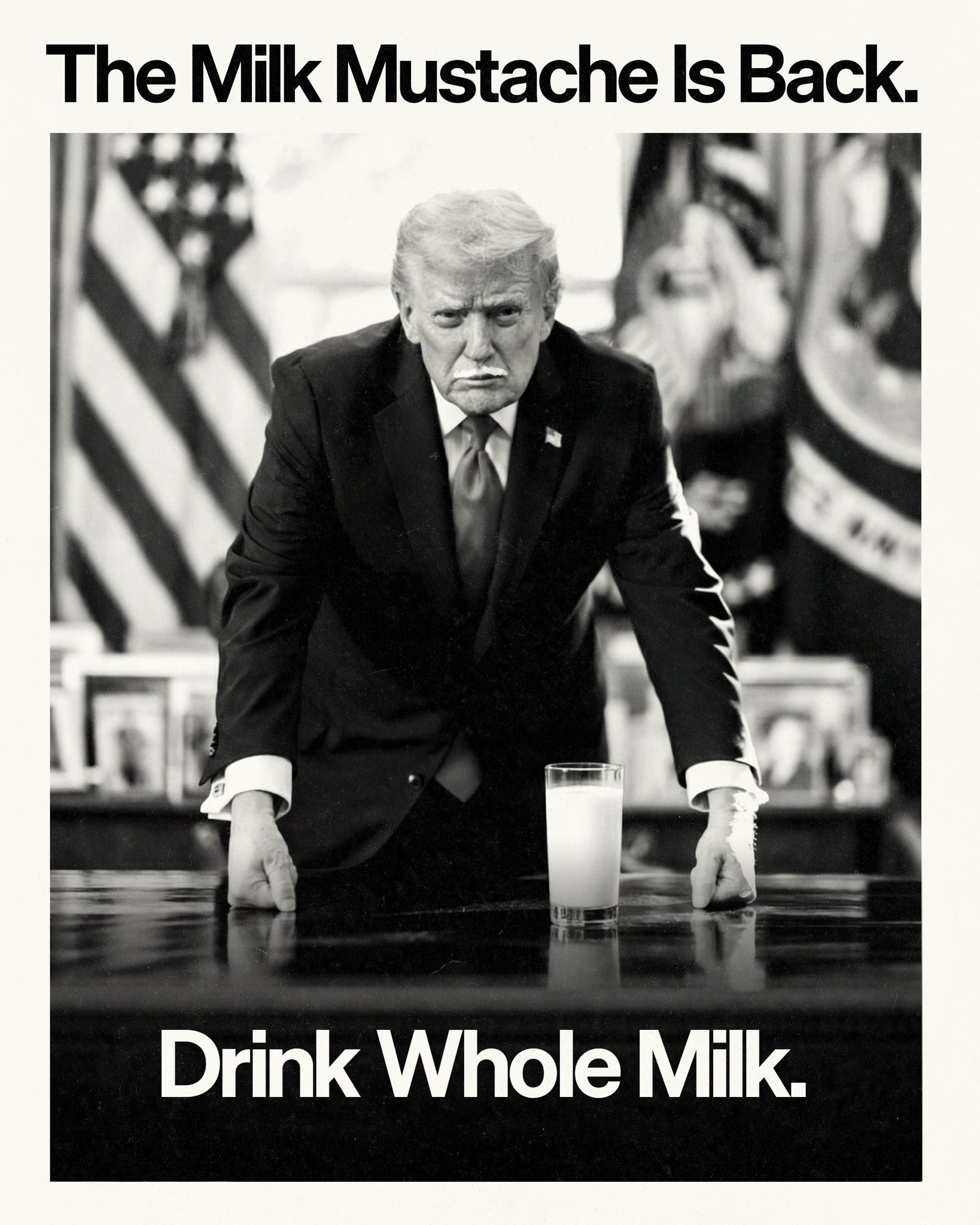
USDA Revives Iconic "Milk Mustache" Campaign Featuring President Trump to Promote Whole Dairy
The USDA launched a new whole milk marketing campaign featuring President Trump with the iconic milk mustache, tying into the upcoming signing of the Whole Milk for Healthy Kids Act and the administration's new dietary guidelines that put full-fat dairy at the center of recommended eating.
# USDA Revives Iconic "Milk Mustache" Campaign Featuring President Trump to Promote Whole Dairy
The U.S. Department of Agriculture launched a bold new marketing push for whole milk on January 11, 2026, featuring President Donald Trump sporting the iconic milk mustache made famous by the "Got Milk?" advertisements of the 1990s and 2000s.
The black-and-white image, shared on the USDA's official social media channels, shows Trump leaning against his Oval Office desk with a glass of whole milk, a line of milk visible on his upper lip beneath the headline: "The Milk Mustache Is Back. Drink Whole Milk."
The post, accompanied by the hashtag #DrinkWholeMilk, quickly amassed millions of views and sparked widespread discussion across social media platforms.
---
## A Victory Lap for Dairy Policy
The campaign arrives just days before President Trump is expected to sign the **Whole Milk for Healthy Kids Act** on January 14, 2026, legislation that passed both chambers of Congress with bipartisan support. The bill reverses Obama-era restrictions from 2012 that limited schools to unflavored 1% milk, unflavored skim milk, and flavored skim milk.
Under the new law, schools participating in the National School Lunch Program will be able to offer whole milk, 2% milk, low-fat, and fat-free options in both flavored and unflavored varieties. The legislation also excludes milk fat from the 10% saturated fat limit calculations for school meals.
The Whole Milk for Healthy Kids Act passed the Senate by unanimous consent on November 20, 2025, and cleared the House by voice vote in December.
---
## New Dietary Guidelines Shift the Pyramid
The milk mustache campaign is part of a broader push by the Trump administration to reshape American nutrition policy. On January 7, 2026, Health Secretary Robert F. Kennedy Jr. unveiled the **2025-2030 Dietary Guidelines for Americans**, which represented what the administration called "the most significant reset of federal nutrition policy in decades."
The new guidelines essentially flip the traditional food pyramid on its head:
- **Grains**, once the foundation of recommended eating, are now the smallest category
- **Protein, dairy, fats, fruits, and vegetables** compete for the top of the pyramid
- **Full-fat dairy** is recommended instead of the low-fat options emphasized in previous guidelines
- **Three servings of whole dairy per day** are suggested
- **Ultra-processed foods** and added sugars are targeted for reduction
"By prioritizing real food, not ultra-processed foods, added sugars, and refined carbohydrates, these guidelines restore commonsense and science to health policy," the White House stated in a press release.
---
## Industry Celebrates Return to Whole Milk
Dairy industry groups have welcomed both the new guidelines and the legislative changes.
"The new Dietary Guidelines send a clear and powerful message to Americans: dairy foods belong at the center of a healthy diet," said **Michael Dykes, DVM**, President and CEO of the International Dairy Foods Association. "Recommending the consumption of whole and full-fat dairy products such as whole milk, yogurt, cheese, and other dairy products is an important victory for consumer choice and public health."
The **American Farm Bureau Federation** also praised the shift. "The new dietary guidelines acknowledge the value of prioritizing high-quality protein, dairy, and fresh fruits and vegetables," said Federation President **Zippy Duvall**.
For the dairy industry, the policy changes address a persistent challenge: school milk consumption has been declining for years. Weekly milk servings dropped 15% between 2008 and 2018, with the decline accelerating 77% after the 2012 restrictions took effect.
---
## Potential Market Impact
Industry analysts estimate the return of whole milk to schools could significantly boost butterfat utilization:
| Adoption Scenario | Estimated Annual Butterfat Impact |
|-------------------|-----------------------------------|
| 25% of schools adopt whole milk | 18 million lbs |
| 50% of schools adopt whole milk | 36 million lbs |
| Near-universal adoption | 45-66 million lbs (2-3% of U.S. production) |
Each whole milk carton contains approximately 8 grams of fat compared to 2.5 grams in low-fat milk. With the National School Lunch Program serving approximately 30 million students, even modest adoption could create meaningful new demand.
---
## Health Experts Urge Caution on Portions
While many health organizations applauded aspects of the new guidelines, particularly the emphasis on whole foods over processed options, some experts cautioned about portion awareness.
Harvard's T.H. Chan School of Public Health illustrated the challenge of staying within recommended saturated fat limits. In a standard 2,000-calorie diet, 10% of calories equals about 22 grams of saturated fat. One serving each of whole milk, whole-fat Greek yogurt, and whole-fat cheese adds up to 17 grams of saturated fat before any other foods are considered.
"If you were to add a single tablespoon of butter (7 grams) or beef tallow (6 grams), both suggested cooking fat options, you're over the limit. And this isn't even considering other foods consumed throughout the day," the school's website noted.
The **American Heart Association** encouraged "consumption of low-fat and fat-free dairy products, which can be beneficial to heart health," while acknowledging positive elements in the guidelines.
**Karen Peterson**, chair of nutritional sciences at the University of Michigan's School of Public Health, noted that "advocating consumption of red meat and high-fat dairy food without specific guidelines for portion size and servings can easily counter consumers' efforts to simultaneously keep energy intake from saturated fats below 10%."
---
## The Whole Milk Debate: What the Science Says
Recent research has added nuance to the long-standing debate over whole versus reduced-fat dairy.
According to the **Mayo Clinic**, new studies suggest that full-fat milk, cheese, and yogurt "may not have the negative effects on heart or vascular health as previously thought."
Whole dairy offers several advantages:
- More nutrients, including protein, calcium, phosphorus, and vitamins A, B, and D
- Essential omega-3 fatty acids
- Better satiety, helping people feel full longer
- Improved absorption of fat-soluble vitamins
The University of Washington notes that our bodies need certain types of fats to function properly, and whole dairy is a good source of these "healthy" fats.
However, the choice between whole and low-fat dairy ultimately depends on individual dietary needs. Those managing saturated fat intake for cardiovascular health may benefit from reduced-fat options, while others may prioritize the additional nutrients in whole dairy.
---
## What Comes Next
The USDA is expected to begin rulemaking to implement the Whole Milk for Healthy Kids Act, with schools potentially able to offer whole milk as early as the 2026-2027 school year.
The administration has framed these changes as part of its broader "Make America Healthy Again" initiative, which emphasizes minimally processed foods, high-quality proteins, and a return to what it calls "real food."
For dairy producers navigating tight margins and evolving consumer preferences, the policy shift represents a potential new source of demand. Whether the iconic milk mustache can drive sustained changes in consumption habits remains to be seen, but the Trump administration is clearly betting on the power of whole dairy.
---
*Sources: [USA Today](https://www.usatoday.com/story/news/health/2026/01/12/trump-milk-mustache-usda/88145160007/), [The White House](https://www.whitehouse.gov/articles/2026/01/what-they-are-saying-trump-administration-puts-real-food-first-in-dietary-guidelines/), [USDA](https://www.usda.gov/maha), [Harvard T.H. Chan School of Public Health](https://nutritionsource.hsph.harvard.edu/), [International Dairy Foods Association](https://www.idfa.org/), [American Farm Bureau Federation](https://www.fb.org/)*
*Have a story tip or industry news to share? Contact us at [info@therio.ai](mailto:info@therio.ai).*